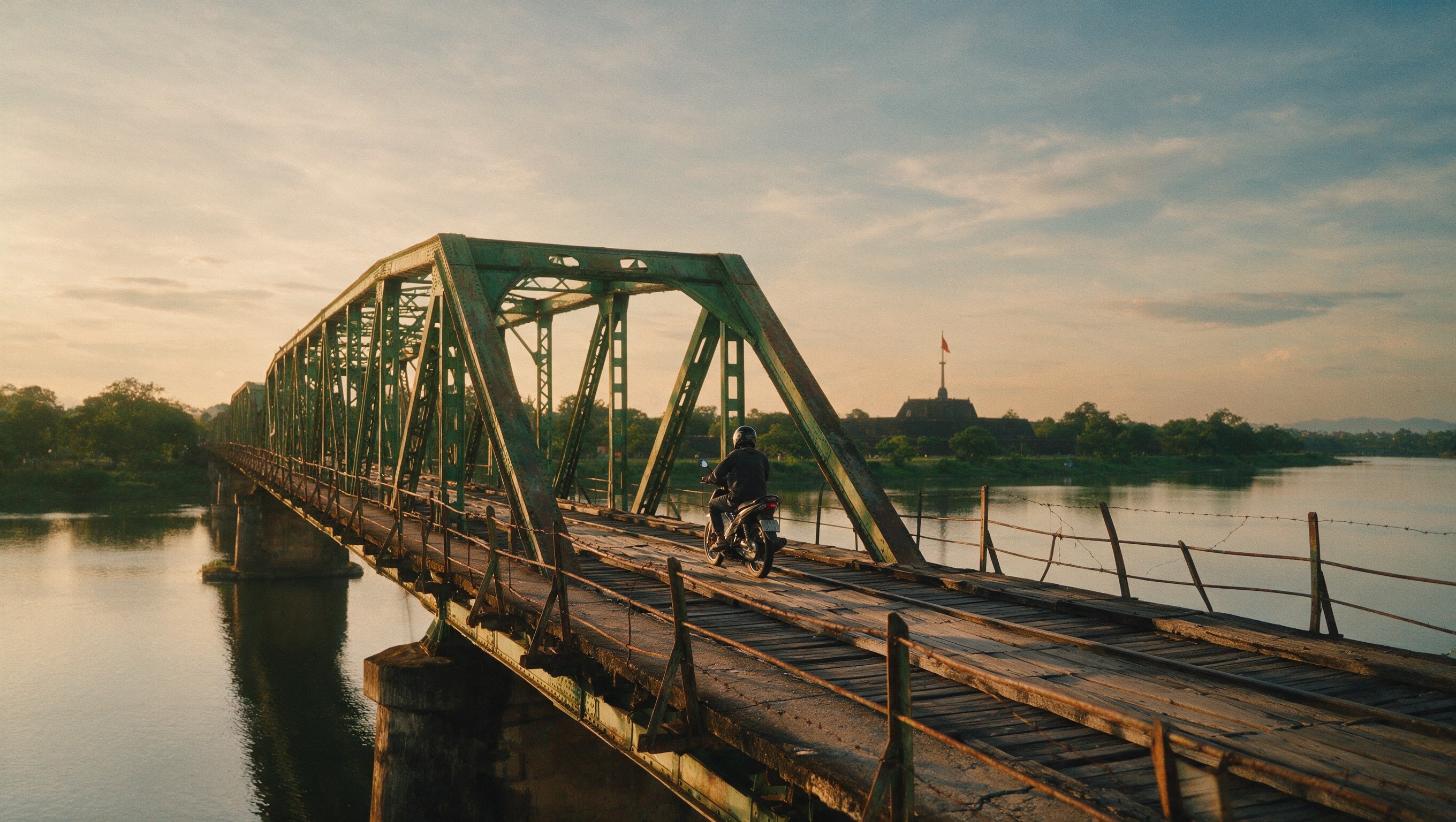
Vietnam rainy season for riders: why the north, the centre and the south are wet in different months
When it rains in Vietnam by region according to Vietnamese government climate reports and the FAO country profile: the north and the south in summer, the central coast in autumn, the Central Highlands in between, how many typhoons a year, Hue and Hanoi in numbers, five cities month by month, and how to ride on a wet road.
Fact-checked: October 31, 2026
Live rental prices, and every bike shows whether it needs a licence
Browse bikesThe short answer
Vietnam has no single rainy season. The north and the south are wettest in the summer months, the central coast is wettest in autumn, and the Central Highlands sit in between. So the question to ask is not when it rains in Vietnam but when it rains where you will ride. If your route crosses regions, the same week can be dry in one and soaked in another.
A note on the sources. We could not open an official Vietnamese weather-service page, and travel blogs disagree with each other on the dates of the central coast, so we do not use them. The season dates below are from the Wikipedia article on the climate of Vietnam, which takes them from the Viet Nam Assessment Report on Climate Change, published by the Vietnamese Institute of Strategy and Policy on Natural Resources and Environment with UNEP taking part, and from the FAO country profile; we read the article, not the original reports. Treat the months as the usual pattern of a region, not as a forecast for a given year.
The north and the northwest
In the north, the Red River Delta where Hanoi lies, the rainy season begins in April or May, peaks in July and August and ends in October or November. In the northwest highlands, where Sapa is, it begins in April or May, peaks in July and August and ends in September or October, and the dry season usually lasts four to five months.
The numbers for Hanoi, from the national building-code climate tables: January averages 16.4 degrees, February 17.2 and December 18.2, with 18 to 20 mm of rain a month in those winter months and 1,611 mm in a year. So the northern winter is dry but cool. The mountains are colder: in the same tables January in Sapa averages 8.7 degrees. The monthly rainfall for Sapa is further down, among the five cities. The Ha Giang Loop and its costs are in /en/guide/ha-giang-loop-price.
The central coast: Hue and Da Nang
On the north central coast, which includes Hue, the rainy season begins in August or September, peaks in October and November and ends in November or December; September and October have the most rain. The south central coast, where Da Nang is, begins in August or September, peaks in October and November and ends in December, and a general line in the sources runs from September to December or January. For Hue the building-code table gives 2,798 mm of rain a year and 757 mm in October alone.
This is the part of the country where the rainy months are most different from the north and the south. The Hai Van Pass and the Son Tra Peninsula near Da Nang are in /en/guide/riding-danang, and the rentals of the city in /en/guide/rent-danang.
The Central Highlands and the south
In the Central Highlands, where Da Lat and Buon Ma Thuot are, the rainy season begins in April or May, peaks in August and ends in October or November, and the winters are dry. In the south, the Mekong Delta and the area of Ho Chi Minh City, the rainy season begins in May and runs, in the wording of the sources, between May and November. For the delta the building-code table gives 1,674 mm a year in Can Tho.
We deliberately do not place Mui Ne, Phu Quoc, Hoi An or Ninh Binh on this regional map: the climate source does not name them, and a coastal town can be wetter or drier than the region it belongs to. For those, ask the rental in the reply about the weather of your dates. Five other cities do have measured monthly figures, in the next section.
Five cities in millimetres
For five cities we hold long-term monthly rainfall averages from the Vietnam Institute for Building Science and Technology, the same tables our route pages use. In millimetres, January to December. Da Nang: 82, 24, 25, 35, 81, 83, 93, 141, 351, 628, 448, 218. Da Lat: 9, 21, 64, 170, 212, 204, 233, 238, 283, 245, 94, 36. Sapa: 70, 73, 104, 213, 340, 381, 461, 451, 303, 201, 106, 65. Nha Trang: 38, 16, 31, 35, 70, 59, 36, 50, 159, 302, 332, 153. Ha Giang: 40, 39, 65, 106, 295, 430, 545, 415, 241, 154, 84, 42.
What the numbers say, in our reading. Da Nang: October alone brings 628 mm, and February and March are the driest at about 25 mm. Nha Trang: October and November bring 302 and 332 mm, while February has 16 mm and the first half of the year stays at 70 mm a month or less. Ha Giang: July brings 545 mm, fourteen times February, and the wet stretch runs from May to September. Sapa is wet from May to September with July at 461 mm, and no month there is really dry, January still has 70 mm. Da Lat: the rain is from April or May to October, with April at 170 mm, May at 212 mm and September at 283 mm, and January has 9 mm. These are city figures, not mountain pass figures: a pass above the city has its own weather, and we say so on the route pages.
The routes themselves are on their pages: the Hai Van Pass and the Son Tra Peninsula in /en/guide/riding-danang, the Hon Ba road in /en/guide/riding-nha-trang, the O Quy Ho Pass in /en/guide/riding-sapa and the Da Lat roads in /en/guide/riding-dalat.
Typhoons
According to the national report of Vietnam to the UN climate convention, which the Wikipedia article cites, Vietnam is affected by about six to eight typhoons or tropical cyclones a year. The sources we read do not give the months, so we do not either. The practical rule does not need months: when a typhoon is forecast for the coast where you ride, do not ride, and do not argue with the rental if it asks you to bring the bike back.
Riding on a wet road
This is ordinary riding sense, not local data. A wet road is slippery and stopping takes longer, so ride slower and keep more distance, and be careful on painted lines and metal covers. Mountain roads in rain are the worst case: fog, runoff and loose gravel on the same bend. Two people and luggage make a small bike brake and climb worse. Ask the rental for a raincoat; some list one with the bike. The licence you need is in /en/guide/insurance-and-licence and the fines in /en/guide/traffic-fines. We are a platform and not a rental; in a dispute we take the side of the guest.
Every bike on EastRide shows whether it needs a licence.
Browse bikes of Vietnam